
Great Britain and Britain do not mean the same thing.
Great Britain is made up of Scotland, England and Wales, where as Britain is just England and Wales. The name Britain goes back to Roman times when they called England and Wales "Britannia" (or "Britannia Major", to distinguished from "Britannia Minor", ie Brittany in France). The Roman province of Britannia only covered the areas of modern England and Wales. The area of modern Scotland was never finally conquered.
In 1998 the UK government granted devolution to Scotland (and Wales). It recognised the fact that Scotland was a separate country from Britain and as a result Scotland was treated differently in the devolution process. It had some of its sovereignty returned and was given its own parliament with law making powers, whilst all English and Welsh law remains with the UK Parliament.
In 2003/4 when "The Tour of Britain Cycle Race" was re-introduced. The race did not include Scotland. Note the title Tour of Britain.
http://www.woodlands-junior.kent.sch.uk/customs/questions/britain/britain.htm
Wednesday, September 03, 2008

Wednesday, August 20, 2008
Why Team GB (Great Britain) ?
Question sent via email:
Your website is terrific, and I really enjoyed refreshing my knowledge about Great Britain, the United Kingdom, and the Union Jack. A topical question has been bothering me, and no-one I have asked has come up with an answer. Do you know why our team at the Olympics is referred to as “Great Britain”? There is not a separate team from Northern Ireland, is there? And anyway, they all wave the Union flag. Shouldn’t they be call Team UK? Any idea?
Kind regards
Brian
Team GB is the Great Britain and Northern Ireland Olympic Team. The British Olympic Association (BOA) is the National Olympic Committee for Great Britain and Northern Ireland. Why they shorten the name could be because it is too long, but it is not fair on Northern Ireland.
http://www.olympics.org.uk/beijing2008/aboutteamgb.aspx
Find out more about the names of the different parts of the United Kingdom
The difference between England, Britain and the UK
Your website is terrific, and I really enjoyed refreshing my knowledge about Great Britain, the United Kingdom, and the Union Jack. A topical question has been bothering me, and no-one I have asked has come up with an answer. Do you know why our team at the Olympics is referred to as “Great Britain”? There is not a separate team from Northern Ireland, is there? And anyway, they all wave the Union flag. Shouldn’t they be call Team UK? Any idea?
Kind regards
Brian
Team GB is the Great Britain and Northern Ireland Olympic Team. The British Olympic Association (BOA) is the National Olympic Committee for Great Britain and Northern Ireland. Why they shorten the name could be because it is too long, but it is not fair on Northern Ireland.
http://www.olympics.org.uk/beijing2008/aboutteamgb.aspx
Find out more about the names of the different parts of the United Kingdom
The difference between England, Britain and the UK
Thursday, May 01, 2008
May Day
The first day of the month of May is known as May Day. It is the time of year when warmer weather begins and flowers and trees start to blossom. It is said to be a time of love and romance.
The history of the May Day celebrations go back to at least the Roman empire and may even further to the Celts.
You can find out more about May Day, on our website.
www.woodlands-junior.kent.sch.uk/customs/questions/mayday.htm
The history of the May Day celebrations go back to at least the Roman empire and may even further to the Celts.
You can find out more about May Day, on our website.
www.woodlands-junior.kent.sch.uk/customs/questions/mayday.htm
Tuesday, April 22, 2008
St George's Day
St. George's Day is on April 23rd. It is England's national day.
You can read about this special day and the legend of St George's fight with a dragon on our website:
http://www.woodlands-junior.kent.sch.uk/customs/stgeorge.html
Do you think London should have a major St. George's Day celebration? (different message)
Visit projectbritain.com for more about British life and culture.
You can read about this special day and the legend of St George's fight with a dragon on our website:
http://www.woodlands-junior.kent.sch.uk/customs/stgeorge.html
Do you think London should have a major St. George's Day celebration? (different message)
Visit projectbritain.com for more about British life and culture.
Wednesday, April 02, 2008
New British coins
The Royal Mint today unveiled innovative new designs to feature on the reverse of seven of the United Kingdom’s coins. The coins are expected to enter circulation gradually from this summer, featuring alongside the current 27 billion coins currently in circulation. (Old coins will remain legal tender alongside the new versions.)
The new "reverse" designs for the 1p, 2p, 5p, 10p, 20p, 50p and £1 coins partner the Queen's head on the flip side.
The coins, when put together, form the Shield of the Royal Arms. Parts of the shield are represented on each coin.
2p Rampant lion representing Scotland
5p mixture of all parts of the shield
10p Two Lions representing
20p back end of a lion representing
50p Harp representing Ireland and two lions representing
£1 shows the complete Shield of the Royal Arms (Wales is not represented on the shield. find out why here)
The £2 coin will remain unchanged.
Click here to find out about British coins in circulation right now
The new "reverse" designs for the 1p, 2p, 5p, 10p, 20p, 50p and £1 coins partner the Queen's head on the flip side.
The coins, when put together, form the Shield of the Royal Arms. Parts of the shield are represented on each coin.
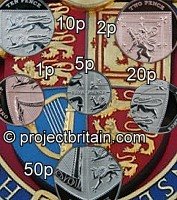
2p Rampant lion representing Scotland
5p mixture of all parts of the shield
10p Two Lions representing
20p back end of a lion representing
50p Harp representing Ireland and two lions representing
£1 shows the complete Shield of the Royal Arms (Wales is not represented on the shield. find out why here)
The £2 coin will remain unchanged.
Click here to find out about British coins in circulation right now
Tuesday, April 01, 2008
April Fools Day
1 st April is known as April Fools Day in England. It is the day when we play pratical jokes on people but only before midday, after that it is considered unlucky.
For more informaion about April Fools Day visit:
www.woodlands-junior.kent.sch.uk/customs/year/april.htm
How is April Fools Day celebrated in other countries?
We have been scouring the Net looking for clues. We are not sure if the follwing are 100% correct. (In searching we found there were many sites with wrong informatin about England)
In Iran, people play jokes on each other on April 3, the 13th day of the Persian calendar new year (Norouz). This day is called “Sizdah bedar” (Outdoor thirteen). It is believed that people should go out on this date in order to escape the bad luck of number 13.
In France 1st April is known as poisson d’avril (literally “April’s fish”). On this day people attempt to attach a paper fish to the victim’s back without being noticed.
In Itlay, the day is known as pesce d’aprile (again literally “April’s fish”) is also used to refer to any jokes done during the day).
In Denmark the 1st of May is known as “Maj-kat”, meaning quite simply “May-cat”, and is identical to April Fools’ day, though Danes also celebrate April Fools’ day (”aprilsnar”).
For more informaion about April Fools Day visit:
www.woodlands-junior.kent.sch.uk/customs/year/april.htm
How is April Fools Day celebrated in other countries?
We have been scouring the Net looking for clues. We are not sure if the follwing are 100% correct. (In searching we found there were many sites with wrong informatin about England)
In Iran, people play jokes on each other on April 3, the 13th day of the Persian calendar new year (Norouz). This day is called “Sizdah bedar” (Outdoor thirteen). It is believed that people should go out on this date in order to escape the bad luck of number 13.
In France 1st April is known as poisson d’avril (literally “April’s fish”). On this day people attempt to attach a paper fish to the victim’s back without being noticed.
In Itlay, the day is known as pesce d’aprile (again literally “April’s fish”) is also used to refer to any jokes done during the day).
In Denmark the 1st of May is known as “Maj-kat”, meaning quite simply “May-cat”, and is identical to April Fools’ day, though Danes also celebrate April Fools’ day (”aprilsnar”).
Thursday, March 20, 2008
Simnel Cake
Simnel Cake is a traditional cake eaten at Easter time. Originally is was made for Mothering Sunday, but today it is more likely to be eaten on Easter day.
We have created a pictorial Simnel cake recipe page on the Woodlands Junior website.
http://www.woodlands-junior.kent.sch.uk/customs/easter/simnelrecipe.html
We have created a pictorial Simnel cake recipe page on the Woodlands Junior website.
http://www.woodlands-junior.kent.sch.uk/customs/easter/simnelrecipe.html
Why the name 'Good Friday' ?
Good Friday is the Friday before Easter Day.
The name is derived from 'God's Friday' in the same way as good bye is derived from 'God be with ye'
http://www.woodlands-junior.kent.sch.uk/customs/easter/goodfriday.htm
The name is derived from 'God's Friday' in the same way as good bye is derived from 'God be with ye'
http://www.woodlands-junior.kent.sch.uk/customs/easter/goodfriday.htm
Subscribe to:
Posts (Atom)

